Dosage Estimator³
Discover how long to use your HeroPanel for. Each setting aims to provide energy as close as possible to that used in related research.
All values are approximate, based on Gembared TES-1333 correction factors. This tool is for educational use only and is not medical advice.
Learn about each "Goal" along with a few of the studies informing their J/cm² estimates below:
Collapsible content
Emulate LED mask (~30 J/cm² red + NIR)
This goal mirrors the gentle, frequently used doses from LED facial rejuvenation protocols. Clinical LED face studies using 633 nm and 830 nm often sit in the tens of J/cm² per session, with good safety for repeated use and gradual improvements in wrinkles, elasticity and texture.
Supported by LED facial studies and reviews:
- Split-face LED RCT using 633 nm and 830 nm showed significant wrinkle reduction and increased elasticity with repeated low-level sessions (Lee et al., 2007).
- Red + NIR facial LED treatment improved fine lines, roughness and collagen density in a controlled trial (Wunsch & Matuschka, 2014).
- Reviews of LED-LLLT for the aging face summarise non-ablative, low-fluence LED protocols as effective and well tolerated (Calderhead & Vasily, 2016).
Best for: Daily / frequent facial use, glow, tone, mild pigmentation, fine lines.
Skin + muscles sweet spot (~60 J/cm² red + NIR)
This sits around the middle of the “effective window” for both skin rejuvenation and musculoskeletal recovery, assuming ~1:1 red:NIR (≈30 J/cm² each).
Supported by PBM research:
- 830 nm LED phototherapy around 60 J/cm² per injury reduced pain and significantly shortened return-to-play time in injured university athletes (Foley et al., 2016).
- Biphasic dose-response review shows many successful deep-tissue protocols in roughly the 10-60 J/cm² range, with reduced benefit at much higher doses (Huang & Hamblin, 2009).
- Facial LED rejuvenation studies using red/NIR also cluster in the 20-60 J/cm² session range with meaningful cosmetic improvements (Lee et al., 2007; Wunsch & Matuschka, 2014).
Best for: Combined skin anti-ageing + muscle recovery, tendons, “feel it working” sessions without going into extreme high-dose territory.
Maximum penetration / advanced (~120 J/cm² red + NIR)
This goal is modelled on high-fluence clinic-style protocols, mainly for short courses rather than daily use.
Supported by high-fluence LED trials:
- Combination 633 nm (≈126 J/cm²) + 830 nm (≈66 J/cm²) LED therapy significantly improved wrinkles, elasticity and skin roughness in a facial rejuvenation trial (Russell et al., 2005).
- Red + NIR LED protocols in similar ranges have shown improvements in photoaged skin and dermal collagen (Wunsch & Matuschka, 2014).
Best for: Short, targeted programs for stubborn wrinkles, deeper photoageing or thicker tissue.
Not something to run daily on the face.
Gentle surface protocol (~20 J/cm² red only)
A low, frequent-use dose for maintenance, glow and subtle repair.
Supported by tissue-repair and PBM dose data:
- Meta-analysis of LLLT for wound repair found beneficial effects mostly at relatively low fluences, with clear evidence that over-dosing is less effective (Woodruff et al., 2004).
- Biphasic dose discussions emphasise that surface tissues often respond best to modest doses, not extremely high ones (Huang & Hamblin, 2009).
Best for: Frequent “skin health” sessions: glow, fine lines, mild tone/pigmentation support.
Hair growth protocol (~67 J/cm² red only)
This is chosen to mirror landmark scalp hair studies.
Supported by androgenetic alopecia research:
- RCT in males with AGA using 655 nm lasers/LEDs showed a ~35% increase in hair counts vs placebo after 16 weeks, with fluences in the ~60-70 J/cm² range per session (Lanzafame et al., 2013).
- Systematic review of LLLT for AGA summarises multiple trials with effective doses around 60-100 J/cm², delivered with combs, caps and helmet devices (Pillai & Mysore, 2021).
Best for: Scalp-focused sessions for hair regrowth and density support.
High-dose skin protocol (~126 J/cm² red only)
This is aligned with the red component of a major facial rejuvenation trial.
Supported by high-fluence red LED:
- Combination protocol delivering 126 J/cm² at 633 nm plus 66 J/cm² at 830 nm improved wrinkles and skin elasticity in photoaged facial skin (Russell et al., 2005).
Best for: Short, time-limited programs targeting photoaging, coarse wrinkles and more resistant skin changes, especially when combined with NIR sessions.
Small/deeper areas (~60 J/cm² NIR only)
A well-supported “workhorse” dose for deeper tissue.
Supported by deep-tissue PBM studies:
- 830 nm LED used around 60 J/cm² per injured area reduced pain and return-to-play time in athletes with soft-tissue injuries (Foley et al., 2016).
- 830 nm LED system delivering ~60 J/cm² per session has also been used to accelerate healing in various acute and infected wounds, with good safety (Min et al., 2013).
- Dose - response review highlights 30-60 J/cm² as a common effective window for deeper tissues before the “too much” zone (Huang & Hamblin, 2009).
Best for: Muscle recovery, tendons, joints, inflammatory soft tissue, and deeper-target NIR sessions.
High-dose large muscle (~150 J/cm² NIR only - advanced)
This reflects the upper end of what’s been explored in some nerve/muscle and rehab-style PBM protocols. Evidence here is more mixed, and it clearly sits near the top of the biphasic curve.
Supported (cautiously) by higher-dose PBM literature:
- Reviews of LLLT in sports and rehab note that some trials have used higher-fluence NIR (100+ J/cm²) for large muscle groups, with benefits in certain settings but also a real risk of diminished or reversed benefit at very high doses (Mussttaf et al., 2019).
- Biphasic dose-response analysis emphasises that once you pass the “optimal window”, more energy can give less benefit, especially for repeated treatments (Huang & Hamblin, 2009).
Best for: Short-term programs on large muscle groups for experienced users who specifically want to push toward high fluences - not a default or daily setting.
NIR part of combo skin study (~66 J/cm² NIR only)
This mirrors the NIR part of the well-known combined facial rejuvenation study.
Supported by red+NIR facial LED research:
- The Russell protocol used ~66 J/cm² at 830 nm plus 126 J/cm² at 633 nm, with significant improvements in wrinkles, roughness and elasticity (Russell et al., 2005).
- This provides a template for pairing a NIR-only session (~66 J/cm²) with a high-dose red-only session (~126 J/cm²) when you want to emulate that clinic-style protocol using separate modes.
Best for: Advanced skin programs where you pair NIR-only and Red-only sessions to emulate clinic-style red+NIR protocols.
Investigate more red light therapy studies on our Wavelength Research pages.
Note: This calculator uses Gembared-adjusted TES-1333 readings which are intended to reflect the sensitivity curves of a ThorLabs optical power meter, the measuring device used in a large portion of clinical research. This way, instead of having inaccurate uncalibrated solar meter readings (which are overly sensitive to NIR by up to 2.7x!), you can give yourself light exposure which sits within the approximate range studies shown as effective. This is critical because the biphasic dose response means, if you get too little or too much RLT, you will not get the benefits.
How far away should my panel be?
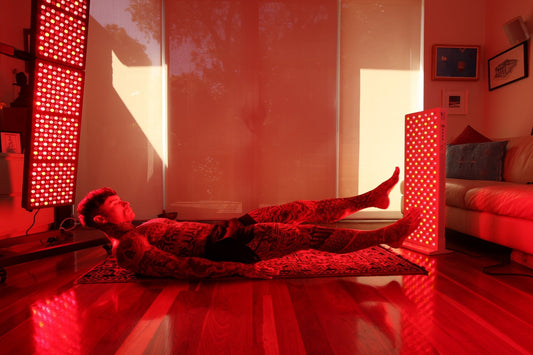
HeroPanels Elite™ users: 6"/15cm for maximum uniformity, 3"/7.5cm if you don't have much time
HeroPanels™ users: 12"/30cm for maximum uniformity, 6"/15cm if you don't have much time
Keep reading to learn why.

The ideal distance is the point where the beams from multiple LEDs overlap smoothly, so every part of the area you’re treating gets a similar dose instead of some spots being blasted and others barely hit.

This matters even more with HeroPanels Elite™ because the equal distribution 10-wavelength design means each colour has fewer LEDs and more spacing; beam overlap is what blends them into a uniform field.

Thanks to the wide 60° lenses, HeroPanels Elite™ reach full multi-LED overlap at around 6"/15 cm, giving perfect smoothing and wavelength mixing at a comfortable close range. You can also use 3"/7.5 cm for smaller areas or when in a rush, while 12"/30 cm is optional for users wanting to illuminate particularly large region or run a gentler, low-irradiance session - but it isn’t required for evenness because that is already achieved at 6"/15cm.
Original HeroPanels™ with 30° lenses need to sit over twice as far away to achieve the same level of blending, which is why their “perfect evenness” distance is closer to 12"/30 cm, with typical use ranging from 6"/15 cm to 18"/45 cm depending on body size.
What makes the 60° Elite™ optics superior is that achieving this perfect evenness closer to the body means far more of the light actually reaches your skin instead of spilling past your sides or lighting the room. At 7.5-15cm, your body occupies a much larger fraction of the beam, resulting in higher capture efficiency, fewer reflections, and far less wasted light compared with using a narrower 30° panel at 12". This is one of the key reasons we upgraded to 60° lenses when designing HeroPanels Elite™: wider optics deliver better blending and ensure more of the emitted energy is used effectively.
Once you’ve chosen the distance that gives you the coverage you want, select that same distance in the calculator above - it will then tell you how long to stay there to hit the right joules to reflect research conducted on your goal³.
Tip: If you're short on time, lowering the distance can help you reach a high dosage quicker at the expense of evenness, but many studies show red light therapy to be effective even at low doses so don't stress about this!
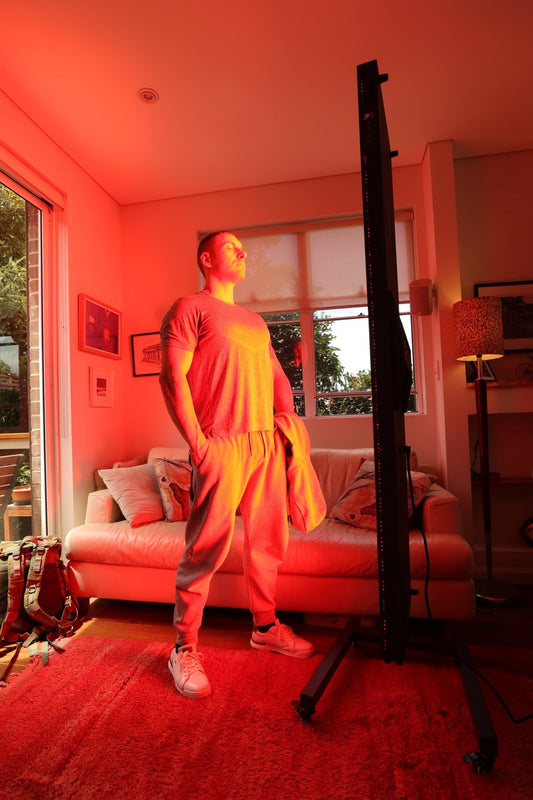
Tip: Don’t forget to treat your back, sides and other hard-to-reach parts of your body!


You might like:
-
HeroPanels Elite™ 10 Wavelength Red Light Therapy Panel
Regular price $1,199.00 - $6,698.00 AUDRegular price$1,199.00 - $6,698.00 AUDSale price $1,199.00 - $6,698.00 AUD -
Hero60™ Tabletop Red Light Therapy Panel
Regular price $999.00 AUDRegular price$999.00 AUDSale price $999.00 AUD -
Hero300™ Red Light Therapy Panel
Regular price $2,199.00 - $2,848.00 AUDRegular price$2,199.00 - $2,848.00 AUDSale price $2,199.00 - $2,848.00 AUD -
Hero960™ Red Light Therapy Panel
Regular price $4,999.00 - $5,698.00 AUDRegular price$4,999.00 - $5,698.00 AUDSale price $4,999.00 - $5,698.00 AUD