Competitor Comparison
Choosing a red light therapy device is more than just a purchase, it’s a personal investment in your self-care and well-being. That’s why we approach our role as a retailer with purpose and integrity. Unlike many competitors, we don’t just sell products - we listen, we guide, and we care. Our focus is on delivering real value through science-backed technology³, honest information, and personalised support.
Your goals matter to us, and that makes all the difference.
We hope this page saves you time and makes your decision easier. If you have any questions or believe we've missed anything, please let us know.
Our Advantages
-

Free Worldwide Shipping
Includes customs clearance and any taxes and import duties⁶. We usually ship with Australia Post, DHL or UPS. Read our Shipping Policy.
-

3-Year Warranty
Rest easy knowing our panels come with a 3-year warranty while other devices have 1 to 2-year warranty. See our Warranty & Support page.
-

60-Day Trial
Use it for up to 60 days and send it back if it's not for you. Used is fine, damaged is not. See our 60-Day Trial page.
-

Aussie Owned
As an ASIC registered company, you can rely on us to meet Australian standards.
-

Lifetime support
We're here to help, even after warranty ends. Use the WhatsApp button to call or message +614 3373 6985, or email hello@redlighthero.com.
-

Global Certifications & Markings
including CE, FCC, RCM, FDA and RoHS, depending on the product. See our Certifications & Testing page.
-

Personal Inspections
We visit the factories which manufacture our products and conduct our own tests on samples of the products we sell.
-

Intelligent Specifications
We put the money where it matters: High irradiance, proven wavelengths³, durable materials, long-life LEDs & ultra-low EMF.
-

No Apps
Meaning no subscription fees and no planned obsolescence.
-

90-Day Best Offer Guarantee
If we improve this offer within 90 days of your order, you get the difference back.⁷ See our 90-Day Best Offer Guarantee.


We've done the research³
It took countless hours to compile research on the wavelengths used in our products. Unlike other brands who make health claims without citing sources, we provide direct links to the RLT studies which inform our product design.
Click the links below to view studies on each of the following or visit our RLT Wavelength Research page for an overview:
- Sleep better
- Reduce pain and inflammation
- Increase muscle mass and recovery
- Stimulate collagen production, rejuvenating skin and wrinkles
- Reverse hair loss
- Improve neural function, depression and brain diseases
- Elevate adenosine triphosphate (ATP) production and boost mitochondria function
- Heal injuries and wounds
- Improve eyesight
We provide guidance
Not only can you contact us anytime, we have also developed comprehensive guides to help you on your red light therapy journey.
We have real reviews from happy customers
Hero300 Elite Comparison Table
Specifications and prices checked 25 August 2026. Prices shown are recommended retail and exclude temporary promotions, which most brands here - ourselves included - run from time to time. Scroll sideways to compare all panels, or use the selector to compare one panel at a time (mobile only). Wavelength rows show all 10 Hero300 Elite wavelengths; competitors may also emit wavelengths not shown in those rows.
Two numbers are easy to misread. Irradiance means nothing without the measurement distance and the beam angle - a narrow beam concentrates the same light into a smaller spot and reports a bigger number (how this works). And a wavelength count means nothing if some of those wavelengths are blue rather than red or near-infrared (why that matters). Both are broken out below.
| Feature | Hero300 Elite | Joovv Solo 3.0 | InfraHeal MAX 7 | Infraredi Pro Max Plus 2.0 | BlockBlueLight PowerPanel MEGA | TLA Pro IV 1500 | Bon Charge Super Max | PlatinumLED BIOMAX 900 | MitoPRO 1500X | Rojo Refine 900 |
|---|---|---|---|---|---|---|---|---|---|---|
| Verification note | Ten wavelengths at a published equal distribution, so you get even coverage. Single-lens LEDs with 100,000 hour lifetime rating, 273 W of measured draw, free worldwide shipping, and a Dosage Estimator calibrated to approximate doses used in clinical research. Every figure in this column is published with the distance and beam angle it was measured at. | The best-known name here, and a little cheaper than Hero300 Elite once converted, but for half the LEDs. Its 74 / 76 red-to-NIR split is effectively even and its LEDs appear to be single-lens, but irradiance is published only as ">100 mW/cm²" with no distance - a base level not a measurement. Hero300 Elite publishes 68.4 mW/cm² on a spectrometer at 15 cm and 123 on a solar meter at the same distance, gives ten wavelengths against two, and a remote rather than an app that can lose support. | Seven wavelengths behind a 30° lens. Both panels publish 7.5 cm (3 in) as the measurement distance and are near-identical in size, so the gap between its 216.5 mW/cm² and Hero300 Elite's 172 - both solar-meter figures at 7.5 cm - is lens concentration, not more light (why beam angle changes the number). Identical at A$2,499 and dearer with a stand - A$2,718 against A$2,588 - for three fewer wavelengths and no published distribution (Hero300 Elite in contrast has an equal amount of all 10 wavelengths). | Its 250 mW/cm² is a solar-meter reading taken at 0 cm - flat against the panel face, where any panel here would post a bigger number (HeroPanels Elite overload solar meters at this distance! See why distance decides irradiance). They publish that same 250 figure for every panel they sell, 84 LEDs to 1,200. With a stand it lands dearer at A$2,599 - for 5 wavelengths at an undisclosed distribution with unclear irradiance, against 10 at a transparent irradiance and equal distribution. | The most transparent competitor here. It publishes a solar-meter figure of 167 mW/cm² and a spectrometer figure of 89 at the same 6", its 60° lens, and its full wavelength split - 16/17/17/14/14/13/9%. Credit where it's due. With a stand the two are basically the same price, so it comes down to what that split shows: seven wavelengths where the weakest arrives at roughly half the share of the strongest, against ten at an equal distribution and dosage guidance. | 12 wavelengths, but 2 of them are blue (why that matters), leaving ten red and near-infrared - level with Hero300 Elite. TLA do not publish how the wavelengths are distributed while HeroPanels Elite provide an equal count of all 10. TLA's LED count is unclear as they state 360 in their specifications but show photos of a panel with 140 LEDs. While we have not tested their devices, dual-lens durability trade-offs may apply to their quad-lens design (at 6"/15cm HeroPanels Elite provide equal coverage anyway, negating any potential advantages of dual/quad chips) | Sold as a full-body panel, but with 210 LEDs to Hero300 Elite's 300 at effectively the same density it is simply a smaller panel - 2,024 cm² against 2,712, roughly a quarter less of you treated per session. Their own range calls the 63 cm Max a half-body device. The page also contradicts itself twice: one year or two on warranty, and 320 W of power against a supplied 60 W adapter. Two wavelengths behind a 30° beam, against ten at a published equal distribution (why the beam angle matters). | Credit for independent measurements. Seven wavelengths, six once its 480 nm blue is excluded, with no published distribution between them. It also draws 484 W to Hero300 Elite's 273 W, using a lot more power, and returns carry a 20% restocking fee. Cheaper with a stand at A$2,052 against A$2,588, but with HeroPanels Elite you get 4 more red and near-infrared wavelengths at an equal distribution of each, similar irradiance, complimentary worldwide DDP shipping and guided dosing. | Credit for independent measurements. Their published split is 6/22/22/17/17/17%, so 590nm arrives at roughly a quarter the share of the strongest, against an equal ten wavelength distribution on HeroPanels Elite. Dual-chip lenses rather than single-lens, no Dosage Estimator and 6 wavelengths with non-US delivery and duties left to the customer - against complimentary worldwide DDP shipping, 10 equally distributed wavelengths and dosage guidance with HeroPanels Elite. | Five wavelengths with a floor stand included, at one of the lower prices in this table. Trade-offs: dual-chip LEDs where Hero300 Elite is single-lens, NIR pulsing we leave out on purpose, no distance and no published distribution while HeroPanels Elite provide equal LED counts. Twice the wavelengths, less electricity consumption (273 W vs 483 W), lower EMF, complimentary worldwide DDP shipping (no customs clearance or import tax dramas!), and guided dosing is what the extra A$593 buys. |
| Wavelengths | 590, 630, 645, 660, 675, 810, 830, 850, 880, 1072 nm | 660, 850 nm | 590, 630, 660, 810, 830, 850, 940 nm | 630, 660, 810, 830, 850 nm | 590, 630, 660, 810, 830, 850, 1060 nm b | 450, 480, 590, 610, 630, 660, 670, 810, 830, 850, 940, 1060 nm | 660, 850 nm | 480, 630, 660, 810, 830, 850, 1060 nm | 590, 630, 660, 810, 830, 850 nm | 630, 660, 810, 830, 850 nm |
| Wavelength count | 10 | 2 | 7 | 5 | 7 b | 12 | 2 | 7 | 6 | 5 |
| Red & near-infrared wavelengths (blue excluded) d | 10 | 2 | 7 | 5 | 7 | 10 | 2 | 6 | 6 | 5 |
| Equal wavelength distribution i | i | Not specified | Not specified | published, not equal | Not specified | published, not equal | Not specified | |||
| Single-lens LEDs | Why single-chip LEDs are better | l | Not specified | |||||||
| Research-informed Dosage Estimator | Open Dosage Estimator | |||||||||
| Irradiance - spectrometer at 15 cm (6") g e | 68.4 mW/cm² measured at 15 cm, 60° beam | Not specified | Not specified | Not specified | 89 mW/cm² peak or average not stated | Not specified | Not specified | 83.1 average 112.2 max | 53.5 average 72.5 peak | 73 mW/cm² peak or average not stated |
| Irradiance - spectrometer at 30 cm (12") g | 61.5 mW/cm² roughly 90% of the 15 cm reading retained | Not specified | Not specified | Not specified | Not specified | Not specified | Not specified | 71.3 average 86% of the 15 cm average retained | Not specified | Not specified |
| Irradiance - solar meter f | 172 mW/cm² at 7.5 cm (3") 123 at 15 cm (6"), both measured | >100 mW/cm² stated as a minimum, no distance k | 216.5 mW/cm² at 7.5 cm (3"), 30° lens, instrument not stated a | 250 mW/cm² at 0 cm, solar meter a | 167 mW/cm² at 15 cm (6") | >200 mW/cm² at 5 cm, instrument not stated a | >130 mW/cm² distance not stated, 30° beam | 185 mW/cm² distance and instrument not stated | >160 mW/cm² at 15 cm (6") | 185 mW/cm² at 15 cm (6") |
| LEDs | 300 | 150 | 300 | 300 | 300 | Unclear n | 210 | 300 | 300 | 300 |
| Panel size / coverage | 91 × 29.8 × 6 cm Half-body | Approx. 91 × 23 cm Half-body | 92 × 30 × 6.5 cm Half-body | 90.8 × 35 cm Half-body | 92 × 30 × 6.5 cm Half-body | 91 × 43 × 7 cm Half-body | 92 × 22 × 6.5 cm Half-body | 91 × 30 × 7 cm Half-body | 109 × 25 cm Half-body o | 91 × 30 × 6.5 cm Half-body |
| 590 nm | ||||||||||
| 630 nm | ||||||||||
| 645 nm | ||||||||||
| 660 nm | ||||||||||
| 675 nm | ||||||||||
| 810 nm | ||||||||||
| 830 nm | ||||||||||
| 850 nm | ||||||||||
| 880 nm | ||||||||||
| 1072 nm | ||||||||||
| Beam angle | 60° | Not specified | 30° | Not specified | 60° | 60° | 30° | 60° | Not specified | 60° |
| EMF | 0 μT @ 7.5 cm (3") | Not specified | “EMF-safe” (no figure) | Not specified | 0.2 μT @ 15 cm (6") | “EMF-free at minimum usable distance” claim names a different model m | “Low EMF” (no figure) | 0 μT @ 10 cm (4") | No detectable EMF at 15 cm (6") | 0.8 mG (0.08 μT) @ 7.5 cm (3") ELF 2 V/m |
| Flicker-free | Not specified | |||||||||
| Pulsing | Omitted by design Why we don't pulse | Not specified | Not specified | (NIR only) | ||||||
| Red / NIR control | ||||||||||
| Timer | ||||||||||
| Brightness | Always full rated output | Adjustable | Not specified | 1-100% | 1-100% | 1-100% | Not specified | Adjustable | Adjustable | Adjustable |
| App | Omitted by design Why we avoid apps | |||||||||
| Physical remote | App / onboard controls | Not specified | App / onboard controls | App / onboard controls | Onboard controls | touchscreen and app; remote only with 2+ panel arrays | App / onboard controls | |||
| Multi-panel synchronisation / expansion | Not specified | Not specified | ||||||||
| Rated lifespan | 100,000 hours | Not specified | Not specified | Not specified | 100,000 hours | 100,000 hours | Not specified | 100,000 hours | Not specified | Not specified |
| Operating noise | 52 dB @ 15 cm (6") | Not specified | Not specified | Not specified | Not specified | Not specified | Not specified | Not specified | Not specified | Not specified |
| Included accessories | Remote, goggles, door-hanging kit, lifting rope, power cable, HeroSync and power-link cables | Eyewear + selected setup hardware | Remote, protective eyewear, door-hanging set and manual | Choice of door hook or base stand at checkout; other inclusions not itemised | Power cable, manual, door hook, hanging cables, pulley system and goggles | Power cord, PDF manual, goggles, door-hanging kit and pulley system | Protective goggles, power cord, door mount and manual | Basic remote; mounting systems sold separately | Power cable, manual, opaque goggles, IR3 glasses, over-the-door hook, steel hanging cables and 4 vinyl straps | Not specified |
| Input power (actual draw) j | 273 W Why 3 W LEDs beat 5 W | 250 VA | Not specified | 470 W | 580 W | Not specified | 320 W | 484.4 W | 418.7 W | 483 W |
| Warranty | 3 years | 2 years | 3 years | 3 years | 5 years | 4 years | 2 years (page also states 1 year) | 3 years | 3 years | 3 years |
| Return policy | 60 days | 60 days | 30 days | 60 days | 30 days | 30 days for faulty, damaged or unused goods; no used change-of-mind returns | 30 days, conditional | 60 days (20% restocking fee may apply) | 60 days | 60 days |
| Free worldwide shipping | Conflicting h | free Australian shipping only | Australia only h | Ships worldwide, not stated as free | free US shipping only | |||||
| Price | A$2,499 | ≈A$2,406 c | A$2,499 | A$2,399 | A$2,349.95 | A$2,349 | A$1,999 | A$1,852 | A$1,845 | A$1,995 |
| Floor stand | A$89 | Included with floor-stand kit | A$219 | A$200 | A$229.95 | A$149 | A$149 | A$200 | A$198 | Included |
| Total price with floor stand | A$2,588 | ≈A$2,406 c | A$2,718 | A$2,599 | A$2,579.90 | A$2,498 | A$2,148 | A$2,052 | A$2,043 | A$1,995 |
| Product link | View product | View product | View product | View product | View product | View product | View product | View product | View product | View product |
- a.
Irradiance figures above 200 mW/cm² are generally produced by measuring very close to the panel and/or using optics that concentrate the beam. Infraredi confirmed its 250 mW/cm² figure is measured at 0 cm. Closer measurements and narrower beam angles raise the reading at a point, but can reduce the evenness of light distribution across the treatment area. Irradiance is only comparable between panels when measured at the same distance and the same beam angle.
- b.
The vendor's own product page contains conflicting wavelength information.
- c.
These prices are published in USD and shown above as approximate AUD conversions. Calculations use an indicative rate of A$1 = US$0.706 and are rounded; delivery, taxes and exchange rates may change the landed cost.
- d.
Some panels include blue wavelengths such as 450 and 480 nm. Blue light sits outside the red and near-infrared range that red light therapy research is built on, and it does not penetrate tissue in the way red and near-infrared light does. This row therefore counts only the red and near-infrared wavelengths each panel emits. See our wavelength research for the studies behind each wavelength we use.
- e.
A narrower beam makes a panel look stronger on paper. Beam angle sets how tightly each lens concentrates its light, so two panels of equal output report very different irradiance unless the distance and the beam angle both match. On a simple geometric model a 30° lens concentrates its output into roughly a quarter of the area a 60° lens covers at the same distance, which raises the reading at a point without producing any more light. Hero300 Elite uses a 60° beam: its 172 mW/cm² solar-meter reading at 7.5 cm (3") is approximately what a 30° panel would read at about 15 cm (6"). This concerns the concentration of the light, not the size of the panel - where two panels have similar dimensions they treat a similar area of the body, and the wider beam trades a lower headline figure for more even delivery with fewer hotspots. This is a geometric approximation intended to aid comparison, not a laboratory measurement.
- f.
Irradiance can be measured with a solar meter or with a spectrometer, and the two do not agree. A solar meter is a broadband sensor calibrated for sunlight: independent laboratory testing of the TES-1333 - the meter used for the readings in this table and for our Dosage Estimator - shows it over-reads red by roughly 1.2x and near-infrared by roughly 2.6x. A panel weighted towards near-infrared therefore posts a much larger solar-meter figure than a red-rich panel of identical real output, and near-infrared is invisible, so the weighting that produces the biggest headline number is the one you cannot see. We measured Hero300 Elite on both instruments at 7.5, 15, 23 and 30 cm: applying those published correction factors to our solar readings reproduces our spectrometer readings to within 2% at 15 cm. Distance compounds the problem - across those same four distances, at an unchanged spectrum, our own solar-to-spectrometer ratio moved from 2.00x to 1.70x on distance alone. BlockBlueLight publishes both figures for the PowerPanel MEGA - 167 mW/cm² by solar meter and 89 by spectrometer at 15 cm - and states that its solar figure is "for competitor comparison purposes only and shouldn't be used for dosing purposes". Several figures in this row are published with no instrument and no distance stated, which means they cannot be converted or compared at all. Our Dosage Estimator works from the corrected values.
- g.
Peak is the single brightest square centimetre; average is what your body actually receives - and the area that average was taken over decides everything. These are not all measured the same way: PlatinumLED's accredited average is taken over a 15 x 15 cm square at the centre of the panel, where any panel reads highest, while Mito's is taken over the full panel footprint, an area roughly ten times larger. A central-patch average and a whole-panel average are different quantities and cannot be ranked against each other. What can be compared is evenness. Mito's accredited pair is 72.5 peak against 53.5 average and PlatinumLED's is 112.2 against 83.1 - drops of 26% each across the measured area, with PlatinumLED's near-infrared varying by 3.4x between its brightest and dimmest points. Sampling across the face of Hero300 Elite in a separate session returns 73.1 peak against a 65.9 average, a 10% drop, which is what a 60° beam is for. Distance matters as much: irradiance from a large panel does not follow the inverse-square law at close range, so a reading at 7.5 cm cannot be compared with one at 15 cm. Hero300 Elite holds roughly 90% of its 15 cm reading at 30 cm; the BIOMAX 900 holds 86%. Five of the panels in this table publish no spectrometer figure at any distance.
- h.
Several vendors advertise "free shipping" that applies only within Australia, or within Australia and New Zealand. InfraHeal's site states "free worldwide shipping" on the product badges and "FREE SHIPPING AU & NZ" in its site banner; that row is marked as conflicting for that reason. This row records free shipping worldwide, not free domestic shipping.
- i.
A wavelength count tells you which wavelengths a panel can emit, not how much of each it delivers. A panel can list a wavelength while assigning only a small number of its LEDs to it, and the published specification will look identical either way. Where a manufacturer does not state the distribution, the intensity of any individual wavelength cannot be determined from the specification. This table marks equal distribution only where the manufacturer states it, and records "Not specified" where it does not. Joovv states a 74 red / 76 near-infrared split across its 150 LEDs, which is close enough to even that this table records it as an equal distribution. BlockBlueLight publishes an unequal split for the PowerPanel MEGA - 16/17/17/14/14/13/9% - which is disclosure without equality: its weakest wavelength arrives at roughly half the share of its strongest.
- j.
Panel wattage is quoted two different ways, and they are not comparable. Some manufacturers publish a nominal LED rating - LED count multiplied by each LED's maximum rating - which produces headline figures like 900 W or 1,500 W. No panel runs its LEDs at maximum, because doing so would overheat the unit, so that figure is a theoretical ceiling rather than anything the panel draws. BlockBlueLight, for instance, advertises 1,500 W for the PowerPanel MEGA - 300 LEDs at 5 W each - while publishing 580 W as what it actually draws. Every competitor figure in this row is that brand's own stated draw, not its marketing headline. Separately, bigger LEDs are less efficient: an LED's wall-plug efficiency falls as its output power rises, so 5 W LEDs produce less light per watt than 3 W LEDs and reach the same irradiance only by drawing more electricity. Hero300 Elite would need 455 W of 5 W LEDs to produce the irradiance it currently produces on 273 W of 3 W LEDs - 182 W of extra power for no extra light. Why 3 W LEDs outperform 5 W
- k.
Joovv publishes its irradiance only as ">100 mW/cm²", with no measurement distance and no upper bound. A figure quoted as a minimum tells you what a panel exceeds, not what it delivers - it is satisfied by 101 mW/cm² as readily as by 200. Every other irradiance figure in this table is a stated value.
- l.
Joovv does not state whether its LEDs are single- or dual-lens. The entry here is our reading of the product photography on their own site rather than a published specification, and we record it as inference rather than as a manufacturer claim.
- m.
TLA's zero-EMF claim appears on the Pro IV 1500 product page but names a different device in the body of the paragraph - the "TLA Black II 1800". We record the claim as it appears and flag it as unverified for this model rather than assuming it carries across.
- n.
Contradictory information; specifications say 360 LEDs, however photos show 140 LEDs. The entry here is our reading of the product photography on their own site rather than a published specification, and we record it as inference rather than as a manufacturer claim.
- o.
Mito claim this is a full-body panel however, being just 20cm longer than most half-body panels and having the same 300 LEDs and a thinner profile, we would still consider it a half-body panel.
EMF and noise readings are only comparable at the same measurement distance; the distance is shown alongside each figure.
“Not specified” means the detail was not found on the current product or policy page; it does not necessarily mean the feature is absent.
The Dosage Estimator provides approximate, research-informed educational guidance and is not medical advice.
Red Light Hero
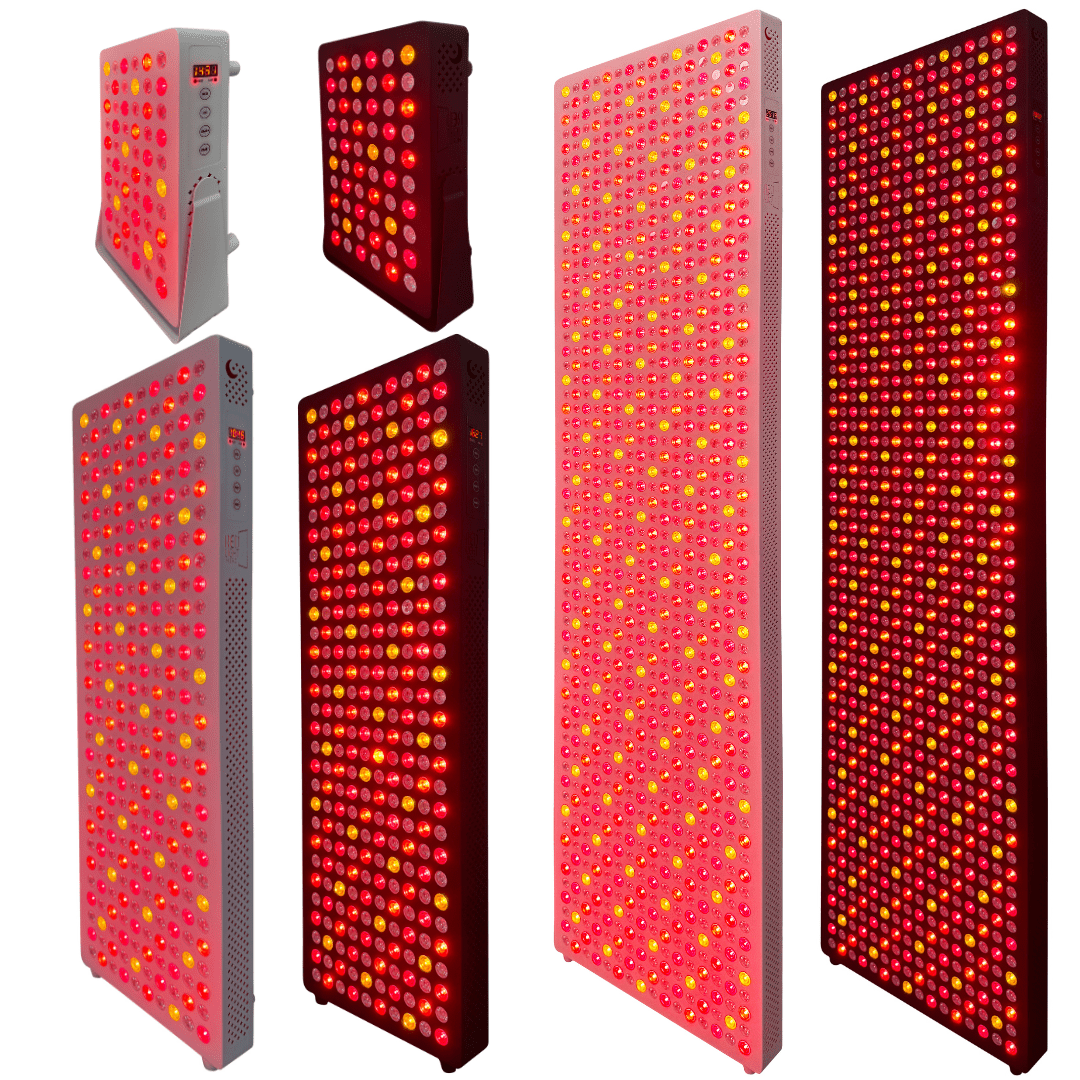
HeroPanels Elite™ 10 Wavelength Red Light Therapy Panel


Compare the Red Light Hero range
Irradiance figures are as published on each product page. Compare solar meter readings with solar meter readings – spectrometer readings are more accurate but much lower, because solar meters over-read near-infrared light (see the HeroPanels Elite™ page for details). On-skin devices are measured touching the skin (0cm), so compare them with each other rather than with panels.
Compare blue light reduction devices
Shop by category
-

All devices
Everything from Red Light Hero in one place: panels, full-body pods, masks...
-

Red Light Hero Panels & Stands
Choose from tabletop, half-body and full-body red light therapy panels, together with...
-

Direct on Skin Devices
These close-contact devices sit against or close to the body, removing the...
-

Red Light Therapy Face Masks & Beauty Devices
Face, neck and skin-focused devices in hands-free, handheld and tabletop formats. HeroMask...
-

Blue Light Blockers & Sleep Tools
Practical tools for keeping evenings softer and less bright: blue-light-blocking glasses, red...


You might like:
-
HeroPanels Elite™ 10 Wavelength Red Light Therapy Panel
Regular price $1,199.00 - $6,698.00 AUDRegular price$1,199.00 - $6,698.00 AUDSale price $1,199.00 - $6,698.00 AUD- 590-1072nm
- 3 sizes
- Lifetime Support
-
Hero60™ Tabletop Red Light Therapy Panel
Regular price $999.00 AUDRegular price- 630-850nm
- Fits most backpacks
- 3-Year Warranty
-
Hero300™ Red Light Therapy Panel
Regular price $2,199.00 - $2,848.00 AUDRegular price$2,199.00 - $2,848.00 AUDSale price $2,199.00 - $2,848.00 AUD- 630-850nm
- Half-body coverage
- 3-Year Warranty
-
Hero960™ Red Light Therapy Panel
Regular price $4,999.00 - $5,698.00 AUDRegular price$4,999.00 - $5,698.00 AUDSale price $4,999.00 - $5,698.00 AUD- 630-850nm
- Full-body coverage
- 3-Year Warranty