Why we don't put blue light in our red light therapy panels
A question we often get is "brand X's panel has seven wavelengths including blue - why don't yours?"
It is a fair question to ask.
The short version: Blue light has its place for niche antimicrobial applications, but it also disrupts sleep and can damage skin so it is not suitable for use within red light therapy panels.
Where blue light may help
Let's start with credit where it is due. Blue light is not useless. The bacteria involved in acne produce porphyrins that absorb light most strongly at about 405-420 nanometres, which is why acne devices use light in the 407-420nm range (Scott et al., 2019). The best known trial gave 107 people daily 15-minute sessions of 415nm blue plus 660nm red for 12 weeks and reported a 76% improvement in inflammatory spots (Papageorgiou et al., 2000).
That is exactly why our HeroMask Elite has an opt-in 415nm "Acne Hero" mode: close to the skin, at the wavelength the research used, with eye shields on, and switched off unless you want it. It's worth noting that when 14 acne trials were pooled, the overall effect was not statistically significant and most trials had a high risk of bias (Scott et al., 2019), and Cochrane rates the evidence for light therapies in acne as low certainty (Barbaric et al., 2016). Promising, targeted, not miraculous.
Notice what that evidence has in common. It is one indication (acne). It is one wavelength band (405-420nm). It is a device held at the face. And it is a meaningful dose. Now look at what the panels are doing.
The blue in those panels is a different colour, and a trace of it
The panels that add blue mostly use 480nm, not 415nm. The stated reason is that 480nm is "long wavelength blue" and therefore safer (source). There is a grain of truth in that for your skin and retina, which we'll come to. But it also means the blue in the panel is not the blue the acne research used. We could not find a single human acne trial at 470-480nm.
Then there is the amount. One of the most popular US panels describes its blue as "a trace amount at 2%" of the panel's output (source), and its own commissioned lab report lists "48 red, 50 infrared, and 2 blue" LEDs in the 100-LED model (lab report). The report measures the red band and the infrared band but no blue band at all. If you subtract red and infrared from the total, everything else comes to about 1.3 mW/cm² at 30cm (64.81 minus 26.84 minus 36.63 in their table), and that is a ceiling, not a measurement. Over a 15-minute session that is at most about 1.2 J/cm² of blue (1.34 mW/cm² × 900 seconds).
Compare that with the clinic acne protocols, which deliver around 40 J/cm² per session from a device 15cm from the face (Tzung et al., 2004, via Diogo et al., 2021; Morton et al., 2005). Even the most generous comparison, the portable 415nm lamp in the Papageorgiou trial, delivered about three times the panel's blue dose (4.23 mW/cm² for 15 minutes a day, about 3.8 J/cm²) at the bacteria's own wavelength, aimed at the face, every day for 12 weeks (Diogo et al., 2021). Or take the one rigorous full-body blue light trial, which gave 87 eczema patients 415nm or 450nm at 40 mW/cm² for 15 minutes (36 J/cm²), three times a week for eight weeks, against a sham. It did not improve a single objective skin score (Buhl et al., 2023; device parameters as reported in Sadowska et al., 2024). That is roughly 30 times the dose a 2% blue channel delivers, at the right wavelengths, and it still failed.
An independent reviewer who put a spectrometer on one of these panels found the blue peak at 466nm rather than 480nm, and on the newer model concluded it "behaves more like a five-wavelength device, as the blue and 1060 nm outputs are negligible" (Light Therapy Insiders, 2024; 2025). Adding blue may make for good marketing, but we haven't been able to find evidence to support its inclusion.
480nm is the one wavelength your body clock is tuned to
Here is the part that bothers us most. Your eyes contain a photoreceptor called melanopsin that tells your brain what time of day it is. It is most sensitive to light at about 480nm (Lucas et al., 2014; Brown et al., 2022). The international standard for measuring this (CIE S 026) puts 480nm at 97% of peak sensitivity, 630nm at 0.04% and 660nm at 0.004% (CIE S 026 dataset). Watt for watt, 480nm is roughly 24,000 times more powerful at telling your brain it is daytime than 660nm red is (our arithmetic from the CIE table: 0.966 divided by 0.0000407).
How much does it take? A consensus of sleep and circadian scientists recommends no more than 10 "melanopic lux" at the eye from three hours before bed (Brown et al., 2022). Run the numbers through the CIE standard and a bit over one microwatt per square centimetre of 480nm reaching an open eye is already at that limit (our arithmetic, using the standard's conversion constant of 1.3262 mW per melanopic lux: Schlangen & Price, 2021). A panel's blue channel is measured in milliwatts, a thousand times larger. In a lab study, 470nm blue at just 40 lux for 45 minutes suppressed melatonin; 630nm red at the same 40 lux did not (Figueiro et al., 2009). Even the brand adding the blue says it does "not recommend night-time light therapy treatment" (source).
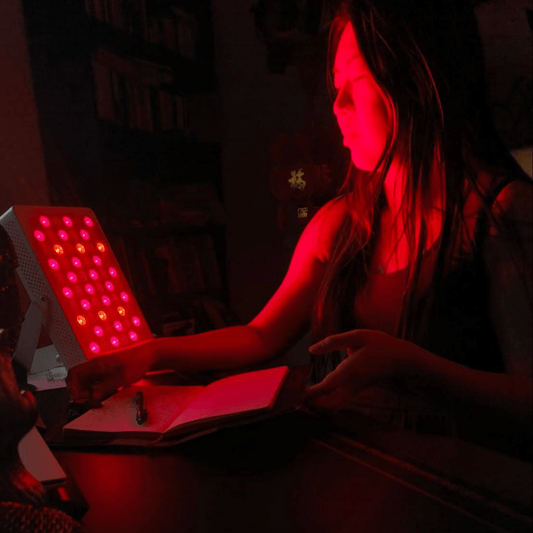
Many of our customers use their panel in the evening as part of their wind-down routine. That only works because there is no blue in it. And notice the catch-22 in the "blue for alertness and mood" pitch: those effects happen through open eyes, which is exactly what your goggles cover.
What blue light does to your eyes
Blue light is a part of the visible spectrum that can damage the retina by a photochemical route rather than by heat. Safety standards weight each wavelength for this "blue light hazard": 415nm scores 0.80, 480nm scores 0.45, and every red wavelength from 600 to 700nm scores 0.001 (EU Directive 2006/25/EC, Annex I; ICNIRP, 2013). That gives blue 450 times the weighting of red (0.45 divided by 0.001). Cree, one of the biggest LED makers, classes its blue LED chips as Risk Group 2 at full current, and says red and green chips "do not pose as significant of an eye safety risk" (Cree LED). France's health and safety agency recommends that LED products sold to the public be Risk Group 0 or 1, and notes that children's eyes filter blue light less well (ANSES, 2019).
To be fair to the other side: 480nm is the least retina-hazardous shade of blue, and the strong evidence of harm comes from bright sources and lab studies, not from screens. But a panel at 30cm is not a screen and we have yet to find a panel brand that publishes a photobiological risk group for its blue channel.
What blue light does to your skin
Blue-violet light is a potent pigmenting wavelength for anyone with olive or darker skin. In a controlled study, 415nm produced a clear dose-dependent tan in skin types III and IV that was more pronounced than UVB and lasted up to three months; 630nm red produced none (Duteil et al., 2014). The sensor responsible has since been identified in melanocytes, and the long-lasting effect appears only in skin type III and above (Regazzetti et al., 2018). Blue light also produced oxidative stress in living skin where green, red and infrared did not (Nakashima et al., 2017). A panel lights your whole body, including all the skin you were not trying to treat. Generally speaking, blue light is best avoided for the skin.
Too weak to treat, too strong for the clock
Put it together and the blue diode ends up in a strange place. It delivers a fraction of an acne dose, at a wavelength no acne trial has used, spread across your whole body instead of aimed at a breakout. But if even one percent of it reaches your open eyes in the evening, it is over the circadian limit. It adds a retinal hazard class that red does not carry and a pigmentation risk that red does not carry, in exchange for a barely-studied wavelength addition.
What we do instead
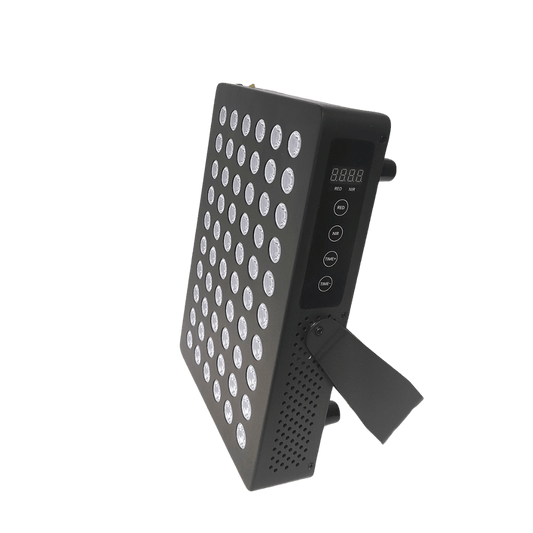
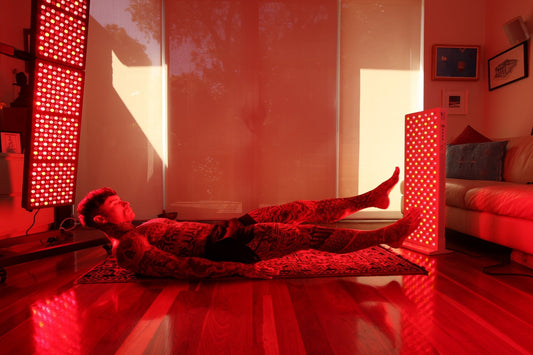
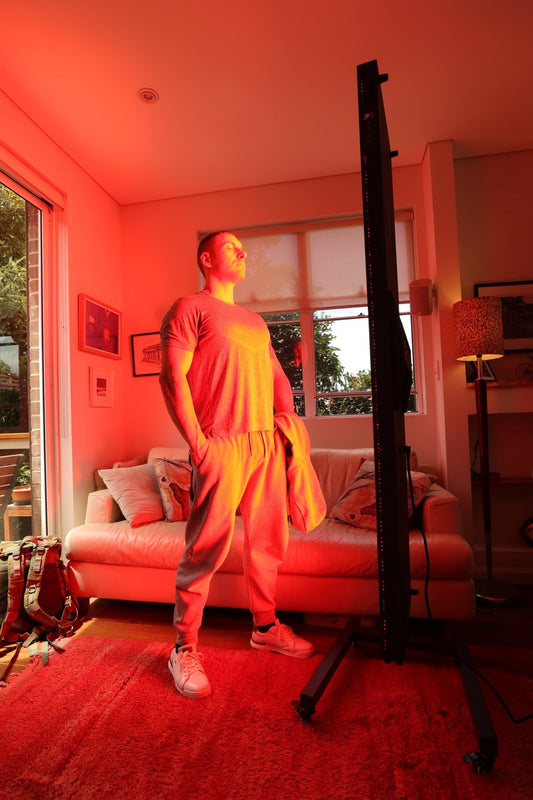
Our panels are red and near-infrared only, and they will stay that way. Where blue has an evidence base - acne, at 415nm, close to the skin, eyes covered, earlier in the day - we put it in a dedicated mode on HeroMask Elite. When we compare panels, we count only the red and near-infrared wavelengths, because a wavelength count that includes blue is telling you about the marketing, not the therapy (see our comparison).
Two practical notes: First, we still ship goggles with every panel - to learn more about eye safety take a look at this blog post. Second, if you already own a panel with blue diodes, check whether the blue can be switched off (on some models it can).
If you have questions about any of this, get in touch - we'd love to help.
References
ANSES. (2019). LEDs: ANSES's recommendations for limiting exposure to blue light. https://www.anses.fr/en/content/leds-ansess-recommendations-limiting-exposure-blue-light
Barbaric, J., et al. (2016). Light therapies for acne. Cochrane Database of Systematic Reviews. https://doi.org/10.1002/14651858.CD007917.pub2 (plain-language summary: https://www.cochrane.org/evidence/CD007917_use-light-therapy-acne)
Brown, T. M., et al. (2022). Recommendations for daytime, evening, and nighttime indoor light exposure to best support physiology, sleep, and wakefulness in healthy adults. PLOS Biology, 20(3), e3001571. https://journals.plos.org/plosbiology/article?id=10.1371/journal.pbio.3001571
Buhl, T., et al. (2023). Full-body blue light irradiation as treatment for atopic dermatitis: a randomized sham-controlled clinical trial (AD-Blue). JDDG. https://pubmed.ncbi.nlm.nih.gov/37814388/
CIE. (2018). CIE S 026 alpha-opic action spectra dataset. https://doi.org/10.25039/CIE.DS.vqqhzp5a
Cree LED. Eye safety with LED components. https://downloads.cree-led.com/files/da/x/XLamp-Eye-Safety.pdf
Diogo, M. L. G., et al. (2021). Effect of blue light on acne vulgaris: a systematic review. Sensors, 21(20), 6943. https://doi.org/10.3390/s21206943
Duteil, L., et al. (2014). Differences in visible light-induced pigmentation according to wavelengths: a clinical and histological study in comparison with UVB exposure. Pigment Cell & Melanoma Research. https://doi.org/10.1111/pcmr.12273
European Parliament and Council. (2006). Directive 2006/25/EC, Annex I. https://eur-lex.europa.eu/legal-content/EN/TXT/HTML/?uri=CELEX:32006L0025
Figueiro, M. G., et al. (2009). Preliminary evidence that both blue and red light can induce alertness at night. BMC Neuroscience, 10, 105. https://doi.org/10.1186/1471-2202-10-105
ICNIRP. (2013). Guidelines on limits of exposure to incoherent visible and infrared radiation. Health Physics, 105(1), 74-96. https://www.icnirp.org/cms/upload/publications/ICNIRPVisible_Infrared2013.pdf
Light Therapy Insiders. (2024, 2025). PlatinumLED BIOMAX 300 and BIOMAX PRO ULTRA reviews. https://www.lighttherapyinsiders.com/platinumled-biomax-300-review/ ; https://www.lighttherapyinsiders.com/biomax-pro-ultra-review/
LightLab International. BIOMAX 300 intensity testing report. https://cdn.shopify.com/s/files/1/0007/9711/4434/files/BIOMAX_300_Intensity_Testing_Report.pdf?v=1756392522
Lucas, R. J., et al. (2014). Measuring and using light in the melanopsin age. Trends in Neurosciences. https://www.sciencedirect.com/science/article/pii/S0166223613001975
Morton, C. A., et al. (2005). An open study to determine the efficacy of blue light in the treatment of mild to moderate acne. Journal of Dermatological Treatment. https://pubmed.ncbi.nlm.nih.gov/16249142/
Nakashima, Y., Ohta, S., & Wolf, A. M. (2017). Blue light-induced oxidative stress in live skin. Free Radical Biology and Medicine, 108, 300-310. https://www.sciencedirect.com/science/article/abs/pii/S089158491730134X
Papageorgiou, P., Katsambas, A., & Chu, A. (2000). Phototherapy with blue (415 nm) and red (660 nm) light in the treatment of acne vulgaris. British Journal of Dermatology. https://pubmed.ncbi.nlm.nih.gov/10809858/
PlatinumLED Therapy Lights. NIR+: the most advanced LED therapy light spectrum and Myths about blue light therapy. https://platinumtherapylights.com/blogs/news/nir-the-most-advanced-led-therapy-light-spectrum ; https://platinumtherapylights.com/blogs/news/myths-about-blue-light-therapy
Regazzetti, C., et al. (2018). Melanocytes sense blue light and regulate pigmentation through opsin-3. Journal of Investigative Dermatology. https://www.sciencedirect.com/science/article/abs/pii/S0022202X17327926
Sadowska, M., et al. (2024). Prospective clinical study: full-body blue irradiation in the treatment of atopic dermatitis. Dermatology and Therapy, 14(9), 2631-2643. https://doi.org/10.1007/s13555-024-01248-3
Schlangen, L. J. M., & Price, L. L. A. (2021). The lighting environment, its metrology, and non-visual responses. Frontiers in Neurology, 12, 624861. https://doi.org/10.3389/fneur.2021.624861
Scott, A. M., et al. (2019). Blue-light therapy for acne vulgaris: a systematic review and meta-analysis. Annals of Family Medicine. https://pmc.ncbi.nlm.nih.gov/articles/PMC6846280/
Tzung, T. Y., Wu, K. H., & Huang, M. L. (2004). Blue light phototherapy in the treatment of acne. Photodermatology, Photoimmunology & Photomedicine, 20(5), 266-269. https://doi.org/10.1111/j.1600-0781.2004.00109.x
Red Light Hero products use clinical-grade LEDs similar to those used in research but are not ARTG-listed medical devices and do not treat or prevent disease. This article is educational only. Consult a healthcare professional before use.