Celebrities & Athletes

What do celebrities & athletes say about red light therapy?
Red light therapy has moved beyond elite training rooms and into the routines of high-profile athletes, experts and entertainers.
Public figures who have discussed using red light therapy include longevity athlete Bryan Johnson, neuroscientist Dr Andrew Huberman, podcaster Joe Rogan, UFC CEO Dana White, and entertainers such as Victoria Beckham, Kim Kardashian, Kourtney Kardashian, Madonna, Jessica Alba, Kate Hudson and Jennifer Lopez.
In professional sport, NBA star LeBron James has described using it for muscle and joint pain, while the San Francisco 49ers became the first professional sports franchise to build a dedicated light therapy recovery room.
We’ve documented what each person or organisation has publicly said below, with sources. These examples reflect their own statements and do not imply endorsement.
The Short Answer
Red Light Hero has no affiliation, sponsorship or endorsement relationship with any person, team or organisation named on this page. They are listed only as public figures who have publicly discussed using red light therapy and/or blue light blocking.
Red Light Therapy
| Name | Known for | Reported use | Source | Closest Hero device |
|---|---|---|---|---|
| Bryan Johnson | Longevity, Blueprint | 655nm scalp cap 6 min daily + whole-body panels ~3x/week | ||
| Dr Andrew Huberman | Neuroscience, Huberman Lab | Whole-body panels; red light at night for sleep | ||
| Victoria Beckham | Fashion, music | At-home LED mask, nightly | ||
| Dana White | UFC CEO | 20-min photobiomodulation in the "Superhuman Protocol" | ||
| Joe Rogan | Podcaster, UFC commentator | Red light bed; recovery and eye health | ||
| Jessica Alba | Acting, Honest Co. | LED light therapy sessions since ~2015 | ||
| LeBron James | NBA | Red light therapy for muscle and joint pain | ||
| San Francisco 49ers | NFL | Dedicated light therapy recovery room at Levi's Stadium | ||
| Kourtney Kardashian | Media, Poosh | LED face mask, collagen and texture | ||
| Kim Kardashian | Media, SKIMS | LED masks for face and neck | ||
| Madonna | Music | Professional photobiomodulation device at home | ||
| Kate Hudson | Acting | LED light therapy for skin | ||
| Jennifer Lopez | Music, acting | Regular Dermalux LED facials |


Swipe for more
Blue Light Blocking
| Name | Known for | Reported use | Source | Closest Hero device |
|---|---|---|---|---|
| Rick Rubin | Music production | Red-tinted blockers before bed | ||
| Erling Haaland | Football, Man City | Blue blockers 3 hrs before bed, nightly | ||
| Dr Jack Kruse | Neurosurgery, photobiology | Advocates blocking artificial blue light | ||
| Dr Andrew Huberman | Neuroscience, Huberman Lab | As well as using red light therapy, Huberman recommends blue light blockers after dark to support circadian rhythm. | ||
| Simon Cowell | Television | Orange-tinted lenses against studio lighting |


Swipe for more
Red Light Hero has no affiliation, sponsorship or endorsement relationship with any person, team or organisation named on this page. They are listed only as public figures who have publicly discussed using red light therapy and/or blue light blocking.
The Long Answer

Biohackers, doctors and longevity figures
This is the group with the most detailed and best-documented protocols.
-
Bryan Johnson
Longevity investor · Founder of Blueprint
Bryan Johnson is probably the most documented red light therapy user in the world because he publishes his entire protocol. RLT appears twice in Blueprint: a 655nm laser cap worn on the scalp for six minutes daily alongside a peptide serum, and whole-body red and near-infrared panel sessions run roughly three times per week for skin, collagen and mitochondrial health.
Source: Blueprint Protocol
The Hero equivalent: the scalp protocol maps to HeroHat Laser™; the whole-body sessions map to Hero960 Elite™.
-
Dr Andrew Huberman
Professor of neurobiology, Stanford · Host of Huberman Lab
Dr Andrew Huberman has covered light therapy extensively on Huberman Lab, including a full episode on using sunlight, blue light and red light to optimise health, and a later episode with UCL researcher Dr Glen Jeffery on red light and metabolic function. He has described using red and near-infrared panels as part of a daily routine, and separately advocates for red-spectrum light in the evening to avoid melatonin suppression before sleep.
Source: Huberman Lab - Using Light to Optimize Health · Huberman Lab with Dr Glen Jeffery
The Hero equivalent: HeroPanels Elite™ for the daily panel routine; HeroReader™ or HeroNightlight™ for evening red-spectrum lighting.
-
Joe Rogan
Podcaster · UFC commentator
Joe Rogan has discussed red light therapy repeatedly on The Joe Rogan Experience, both as a recovery tool and in relation to eye health - referencing the research on red light and age-related decline in retinal function. He has said he uses a red light bed, and when asked directly on-air whether red light therapy works, answered "100 percent." He has also discussed the topic with guests including human biologist Gary Brecka.
Sources: EssentiallySports - Rogan on red light therapy · Rogan and Gary Brecka on red light
The Hero equivalent: HeroPanels Elite™ - and if eyesight is the interest, note that our 10-wavelength Elite range includes the shorter red bands most cited in the vision research.³
-
Gary Brecka
Human biologist · Podcaster
Gary Brecka's "Superhuman Protocol" - the programme he built for Dana White - has four components: a PEMF pad, cold plunge, red light therapy and oxygen therapy. He has discussed it across his own platform and as a guest on other shows, including The Joe Rogan Experience.
Sources: Sportskeeda - White on the protocol · Rogan and Brecka on red light
-
Dave Asprey
Author · Founder of Bulletproof · "Father of biohacking"
Asprey's site states he uses red light therapy daily, alongside other recovery modalities, for cellular inflammation, collagen synthesis and soft-tissue repair. The same article recommends full-body at-home panels for this purpose. No wavelength, distance or session length is published for his own protocol.
Asprey has commercial interests in the light therapy category, including TrueDark and TrueLight, and the article recommends Joovv by name (visit our Competitor Comparison table to learn how we compare).
Source: Health Benefits of Red Light Therapy - daveasprey.com

Athletes who use red light therapy
Red light therapy was used in elite sport long before it became associated with celebrity skincare. Today, it can be found in NFL training facilities, Olympic preparation centres and NBA recovery rooms - typically alongside cryotherapy, compression and hyperbaric oxygen as part of a broader recovery program, rather than as a replacement for them. Two of the best-documented examples are NBA star LeBron James and the San Francisco 49ers, who in 2019 became the first professional sports franchise to purpose-build a light therapy recovery room.
-
LeBron James
NBA · Los Angeles Lakers
LeBron James's recovery programme is almost as well known as his playing career, and is reported to cost around US$1.5 million a year. Red light therapy sits within it alongside cold plunging, cryotherapy, hyperbaric oxygen and Normatec compression, and is used specifically for muscle and joint pain. Asked about the figure directly, James neither confirmed nor denied it, saying what actually matters is "the time."
Sources: Yahoo Finance · UNILAD · Robb Report - James on his recovery routine
The Hero equivalent: Hero960™ full-body panel for whole-body sessions, or the HeroBelt™ for targeted knee, hip and back work.
-
The San Francisco 49ers
NFL · Levi's Stadium
In 2019 the San Francisco 49ers became the first professional sports franchise to build a dedicated light therapy recovery room, constructed adjacent to the team's locker room at Levi's Stadium and announced through an official team partnership. Players use it immediately after games and practice, and the team has since expanded light therapy into its daily training and recovery routine.
Team-level adoption is arguably stronger evidence than any individual endorsement, because it has to survive a procurement process and a medical staff.
Sources: 49ers.com official announcement · optics.org · Sleep Review
The Hero equivalent: HeroPanels Elite™ - the same red and near-infrared wavelength categories, at home scale.
-
Dana White
UFC CEO and President
Dana White has been inspiringly open about the health overhaul he undertook after being told his prognosis was poor. Working with human biologist Gary Brecka, he adopted what Brecka calls the "Superhuman Protocol" - four components: a PEMF pad, cold plunging, red light therapy and oxygen therapy. White has described running roughly 20 minutes of red light therapy / photobiomodulation as part of that sequence, and credits the overall programme with a substantial change in his bloodwork and body composition.
Combat sports is one of the strongest use cases for red light therapy: fight camps compress an enormous training load into eight to ten weeks, and anything that supports soft-tissue recovery without adding systemic stress has obvious appeal.
Sources: Sportskeeda - White details the protocol · FanSided
The Hero equivalent: HeroPanels Elite™ for whole-body sessions; HeroBelt™ for targeted joint and muscle work; HeroTorch™ for spot treatment of specific injuries.

Models, actors, entertainers and musicians
In entertainment, LED light therapy is most visible as skincare: at-home masks and clinic facials used for tone, texture and collagen. Several of the people below have described their routines in some detail, usually to the beauty press, and the devices involved range from consumer LED masks to professional clinic units. The closest Hero equivalent is noted with each entry.
-
Jessica Alba and Kate Hudson
Actors
Both have publicly discussed LED light therapy as part of their skincare routines. Jessica Alba shared images of an LED light therapy session as far back as 2015, as part of a regimen guided by facialist Shani Darden - red light for collagen, blue for acne-causing bacteria. Kate Hudson has described light therapy as one of her main beauty practices, crediting it with helping her skin recover from fatigue.
Source: HELLO! - why celebrities love light therapy
The Hero equivalent: HeroMask Elite™ · HeroBeauty™ 6-in-1
-
Kim & Kourtney Kardashian
Media personalities · SKIMS and Poosh
Kim and Kourtney Kardashian have both made LED light therapy a visible part of their skincare routines. Kim has discussed using LED light facials to help manage her psoriasis. Kourtney alternates between red- and blue-light masks depending on her skin’s needs - red for collagen-focused care and blue for breakouts - and has said she likes being able to wear them while doing other things.
Sources: ELLE - Kim Kardashian’s skincare regimen · Poosh - Kourtney Kardashian’s skincare routine
The Hero equivalent: HeroMask Elite™ · HeroBeauty™ 6-in-1
-
Madonna
Musician
A device in the background of a photo shared from Madonna's home was identified by fans as a Swiss Bio Inov ATP38 - a professional-grade photobiomodulation unit reported to cost around US$23,000, normally found in dermatology, dentistry and physiotherapy clinics and operated by trained staff. Reporting linked it to her recovery from a 2020 hip replacement and knee injury.
Sources: The Mirror US · Music Times
The Hero equivalent: HeroPanels Elite™
-
Jennifer Lopez
Musician
Jennifer Lopez has regular Dermalux LED phototherapy facials as part of a skincare routine focused on tone and fine lines.
Source: Grazia - Jennifer Lopez's skincare routine
The Hero equivalent: HeroMask Elite™ · HeroBeauty™
-
Victoria Beckham
Fashion designer · Musician
Victoria Beckham said on Instagram Stories: "I have noticed such a difference using an at home LED light, and I try to use it every night."
Sources: Grazia · Woman & Home
The Hero equivalent: HeroMask Elite™
-
Red carpets and backstage
Oscars & Beyond
LED light therapy has become a standard part of red-carpet and awards-season preparation, common enough backstage at the Oscars to be a beauty-press story in its own right.
Source: Get The Gloss - LED backstage at the Oscars
The Hero equivalent: HeroMask Elite™
Public figures who use blue light blocking glasses
Blue-light-blocking glasses have also increased in prominence, with several users sharing unusually specific details about their routines. Manchester City striker Erling Haaland says he wears blue blockers for three hours before bed each night. Record producer Rick Rubin wears red-tinted lenses in the evening, while Simon Cowell uses orange-tinted lenses to filter studio lighting. Neurosurgeon Dr Jack Kruse has centred much of his public work on the relationship between artificial blue light and circadian disruption.
-
Erling Haaland
Football · Manchester City
Erling Haaland wears blue light blocking glasses for three hours before bed every night, and has been open about why: "I think sleep is the most important thing in the world. To sleep good, simple kind of things - blue-blocking glasses, shutting out all the signals in the bedroom - I think is really important." His use of them dates back to 2018.
Source: LADbible, July 2026
The Hero equivalent: HeroFilter™ - 100% blue light blocking glasses
-
Rick Rubin
Record producer · Host of Tetragrammaton
Rick Rubin wears red-tinted blue light blocking glasses in the hours before bed, crediting them with better relaxation and deeper sleep. He came to it through Dr Jack Kruse's work on artificial light, and went on to host Kruse alongside Dr Andrew Huberman on his own podcast for a two-part conversation about light and the brain, released April 2023.
Sources: Tetragrammaton - Dr Jack Kruse and Andrew Huberman, Part 1 · Podcast Notes summary
The Hero equivalent: HeroFilter™ for evening wear; HeroReader™ if the goal is reading at night without blue light at all.
-
Dr Jack Kruse
Neurosurgeon · Author on light, circadian biology and mitochondria
Dr Jack Kruse is the most prominent medical voice arguing that artificial blue light is an underappreciated driver of poor health. His position is that indoor lighting and screens deliver blue wavelengths without the balancing full-spectrum light found in sunlight, disrupting melatonin signalling and circadian rhythm. He has appeared on Tetragrammaton with Rick Rubin and Dr Andrew Huberman to discuss it.
Sources: jackkruse.com - why daytime indoor blue light is toxic · Tetragrammaton episode
The Hero equivalent: HeroFilter™ · HeroNightlight™
-
Simon Cowell
Television producer · Music executive
Simon Cowell's orange and red-tinted glasses are one of the more visible examples of blue light filtering in public life. He has explained that they act as a filter against the intense studio lighting he works under all day, which triggers migraines - and that "they actually do work."
Sources: Heart - why Simon Cowell wears orange glasses · Distractify
The Hero equivalent: HeroFilter™ - 100% blue light blocking, for screen work and artificial lighting.
-
Dr Andrew Huberman
Neuroscientist · Host of the Huberman Lab podcast
Beyond red light therapy, Dr Andrew Huberman draws a clear distinction between daytime and evening use. He advises against wearing blue blockers during the day, when blue light supports alertness and helps set the circadian rhythm. At night - particularly when using screens - he says they can help limit light-induced disruption to melatonin, while emphasising that reducing overall brightness still matters.
Source: Huberman Lab - Blue blockers
The Hero equivalent: HeroFilter™ - 100% blue light blocking, designed for screens and artificial lighting after dark.
Why blue light blocking is the other half of the story
Red light therapy adds selected wavelengths; blue light blocking reduces exposure to disruptive ones. The two practices appeal to many of the same people because they follow the same principle: manage the light you receive according to the time of day.
Timing is the key. Blue-rich light helps suppress melatonin and promote alertness in the morning - exactly the signal you want at 8am. The same signal at 10pm can delay the body’s transition towards sleep. Screens, LED downlights and studio lighting can all extend that exposure long after sunset.
The evidence deserves some nuance. Research on blue-light-blocking glasses is mixed, with reviews finding limited or inconsistent benefits for digital eye strain and visual performance. The clearer rationale is circadian: reducing short-wavelength light in the evening as part of a broader routine that also lowers overall brightness. That is also why most of the people below describe wearing them for sleep and evening light management, rather than daytime eye protection.
Read more: HeroFilter™ 100% blue light blocking glasses · Blue light blockers & sleep tools
Why so many public figures use red light therapy
The appeal isn’t tied to a single benefit. It spans four distinct use cases across very different worlds: athletes turn to it for recovery; actors and models for skin; biohackers for mitochondrial function and longevity; and people across every group incorporate it into their evening routines, because red light is generally less disruptive to melatonin production than blue light.

Recovery and inflammation
Red and near-infrared light can reach muscle and connective tissue, where research suggests it may support cellular energy production and help regulate inflammatory signalling.³ For athletes whose income depends on being physically ready - a fighter in camp, a footballer playing twice a week or a swimmer training twice a day - a non-invasive recovery tool with no downtime has obvious appeal. That’s why red light tends to sit alongside cold therapy and compression in elite facilities, rather than replacing them.
Read more: How red light therapy works · The research · HeroPanels Elite™

Skin, collagen and looking good on camera
The skincare use case is the most visible because it’s the one most often photographed. Red light - particularly wavelengths around 630-660nm - has been widely studied for its effects on fibroblast activity, collagen production and skin appearance.³ For actors, models and other people who work on camera, a short session at home is far easier to fit into a routine than another clinic appointment. That convenience helps explain why LED masks have become the most recognisable celebrity red light device.
Read more: HeroMask Elite™ · Skin & wrinkles research

Mitochondrial function and longevity
Biohackers are interested in what red and near-infrared light may do beneath the surface. Photobiomodulation is being studied for its effects on mitochondrial signalling, energy metabolism and cellular resilience - the same systems that feature heavily in performance and longevity research.³ Evidence that red light extends human lifespan is not established, but as a measurable, non-invasive practice that can be repeated consistently, it fits naturally into a longevity-focused routine.
Read more:

Sleep and circadian control
For sleep, red light is often treated as a lighting choice as much as a therapy. Bright, blue-heavy light in the evening can suppress melatonin and delay the body’s transition towards sleep, while dim red-spectrum light is generally less disruptive. The practical protocol is simple: get plenty of natural light during the day, then reduce brightness and short-wavelength light after sunset.
Read more:
Sleep research · HeroReader™ reading lamp · HeroNightlight™ red light nightlight · HeroFilter™ blue light blocking glasses
Bonus: It's non-invasive, low-risk and repeatable
Unlike injectables, surgery or pharmaceuticals, red light therapy is topical, painless and can be done daily at home in under fifteen minutes. Studies indicate it is safe when used as directed.³ For a public figure managing risk to their appearance or their body, that risk profile matters more than the size of the effect.
What devices do they actually use?
Strip away the branding and almost every device on this page falls into one of three categories:
- LED face masks. The most common celebrity device by a wide margin. Flexible or rigid mask covering face and sometimes neck, typically 630-660nm red with some near-infrared. Used 10-20 minutes, most nights. Celebrity-tier pricing runs from a few hundred dollars to well over two thousand. We've developed HeroMask Elite™ around the specs used in skin health research.
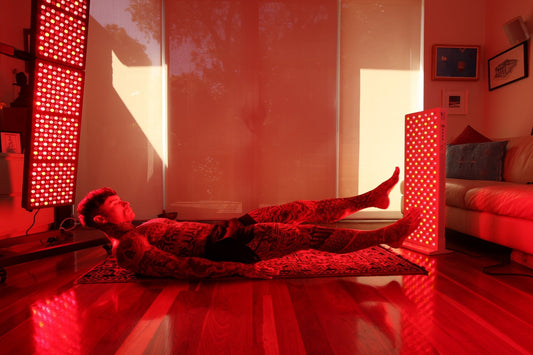
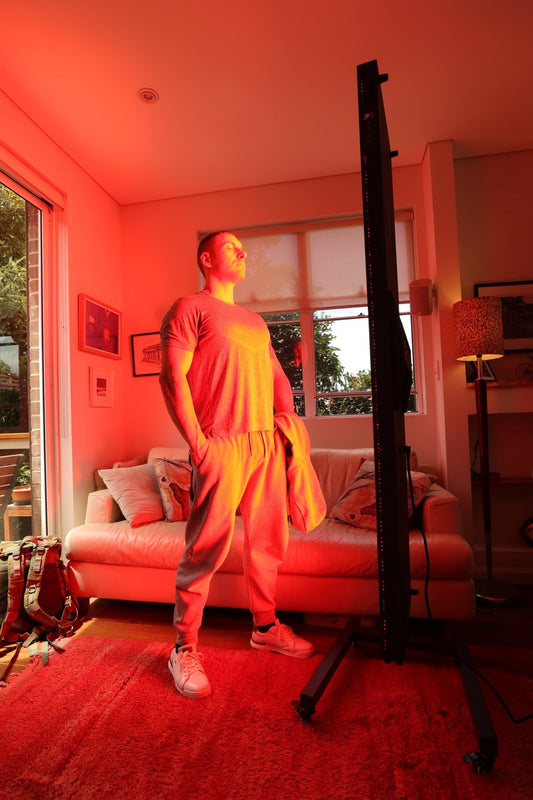
- Whole-body panels. The athlete and biohacker device. Wall-mounted or stand-mounted panels delivering red and near-infrared across a large surface area. Used 5-20 minutes, several times a week. This is what Bryan Johnson, Huberman and NFL facilities are using. We've developed HeroPanels Elite™ as an all-purpose panel reflecting a broad range of research (available in 3 sizes; tabletop, half-body and full-body)
- Targeted wearables. Belts, wraps, caps and torches for a specific joint, muscle or the scalp. Higher near-infrared ratio because the target is deeper tissue rather than skin. Some items we've made which reflect the specs used in direct-on-skin studies include: HeroBelt™ · HeroHat Laser™ · HeroTorch™
What actually matters
The devices on this page are more alike than their marketing may suggest. The differences that affect the light delivered are measurable - and every one of them can be checked:
- Wavelength. Research is concentrated around specific bands: approximately 630-670nm for red light and 810-880nm for near-infrared.³ HeroPanels Elite™ combines ten wavelengths, covering more of the researched spectrum than a conventional two or five wavelength panel.
- Irradiance. Dose depends on the power density at your treatment distance and the length of your session. Figures measured at 0cm rarely reflect real-world use, so we publish measurements at practical distances and provide a Dosage Estimator to help you apply them.
- Coverage and LED distribution. An uneven LED layout can produce an uneven dose. Elite panels use a symmetrical, evenly distributed arrangement designed to provide consistent coverage across the treatment area.
- Beam angle. HeroPanels Elite™'s wide 60° optical lenses allow light from neighbouring LEDs and wavelengths to overlap more evenly, removing isolated hot spots when used from just 15cm away.
- Dose, not guesswork. More is not always better. Red light therapy follows a biphasic dose response, meaning there is an effective range, and exceeding it has been shown to reduce the response. That is why we built the Dosage Estimator - and why it will sometimes recommend a shorter session than you may expect.
Read more: How to choose a device · Certifications and testing · Competitor comparison
Choose based on the physics
A logo does not determine the outcome. The light does: specific wavelengths delivered at a useful power density across enough surface area to matter.
That is what we build, and we publish the numbers so you can verify them for yourself. Ten researched wavelengths.³ Industry standard certifications. Samples periodically tested in-house with a spectrometer, solar meter and EMF reader. A 60-day trial² and a three-year warranty on panels.⁵
Shop the full range · Not sure where to begin? Try our six-step device selector

HeroPanels Elite™ 10 Wavelength Red Light Therapy Panel
Hero60 Elite™ (tabletop) / Black / Built-in stand

HeroPanels Elite™ 10 Wavelength Red Light Therapy Panel
Hero300 Elite™ (half-body) / Black / No stand

HeroPanels Elite™ 10 Wavelength Red Light Therapy Panel
Hero960 Elite™ (full-body) / Black / No stand
 Sale
Sale
HeroMask Elite™ 5-Wavelength Red Light Therapy Mask & Neck Devices

HeroSnug™ Red Light Therapy Sleeping Bag / Dual Mat Pod

HeroBelt™ Red Light Therapy Belt

HeroHat Laser™ Red Light Therapy Hat
HeroHat Laser

HeroFilter™ 100% Blue Light Blocking Glasses
Small
Celebrity & Athletes Frequently Asked Questions
Sources for each answer are linked further up this page.
Which celebrities use red light therapy?
Public figures who have discussed using red light therapy include Bryan Johnson, Dr Andrew Huberman, Joe Rogan, Dana White, Victoria Beckham, Kim Kardashian, Kourtney Kardashian, Madonna, Jessica Alba, Kate Hudson and Jennifer Lopez. In professional sport, LeBron James has described using it for muscle and joint pain, while the San Francisco 49ers built a dedicated light therapy recovery room at Levi’s Stadium in 2019.
Which athletes use red light therapy?
LeBron James has described using red light therapy for muscle and joint pain as part of a broader recovery program - widely reported to cost around US$1.5 million a year - that also includes cryotherapy, hyperbaric oxygen and compression. At team level, the San Francisco 49ers became the first professional franchise to build a dedicated light therapy recovery room, opening it beside the locker room at Levi’s Stadium in 2019.
What red light therapy device does Bryan Johnson use?
Bryan Johnson’s published Blueprint protocol has included a 655nm laser cap, worn for six minutes each day alongside a peptide serum, as well as whole-body red and near-infrared panel sessions approximately three times a week. By device type, the closest Hero options are HeroHat Laser™ for the scalp and a large-format panel such as Hero960 Elite™ for whole-body sessions.
Does Andrew Huberman recommend red light therapy?
Dr Andrew Huberman has discussed the potential uses of red and near-infrared light extensively, but his guidance is more nuanced than a blanket recommendation. Huberman Lab has published a dedicated episode on using sunlight, blue light and red light to optimise health, as well as a discussion with UCL researcher Dr Glen Jeffery on red light and metabolism. Huberman has also described experimenting with red and near-infrared panels. For evening lighting, his emphasis is on reducing overall brightness, with dim red-spectrum light generally being less disruptive to circadian timing than bright, blue-rich light.
Why do athletes use red light therapy?
Athletes primarily use red light therapy to support recovery from training, muscle soreness and inflammation. Photobiomodulation research suggests that red and near-infrared wavelengths may influence mitochondrial activity, cellular energy production and inflammatory signalling.³ Because sessions are non-invasive, require no downtime and can be repeated regularly, the therapy fits easily alongside established recovery practices such as compression and cold exposure.
How much does a celebrity-grade red light therapy device cost?
At the clinical end of the market, photobiomodulation systems can cost more than USD $20,000. The Swiss Bio Inov ATP38 device reportedly photographed in Madonna’s home, for example, is priced at around USD $23,000. Our devices use comparable combinations of commonly studied red and near-infrared wavelengths at a fraction of that - current pricing is on each product page, and the comparison table shows how the panels line up against other consumer brands.
What wavelengths do celebrity red light devices use?
Most consumer red light therapy devices - whether owned by a celebrity or anyone else - use 660nm red and 850nm near-infrared light. These are among the most widely used and studied wavelengths in photobiomodulation but are also cheaper to manufacture.³ More advanced devices may include additional wavelengths across the broader 590-1072nm range. HeroPanels Elite™ combines ten wavelengths to cover more of that researched spectrum than a conventional two or five-wavelength panel.
Is red light therapy just a celebrity trend?
No. Photobiomodulation has been studied for decades and was used in clinical and sports settings long before it became part of celebrity skincare routines. Celebrity adoption has made the technology more visible, but a famous user is not evidence that a device works. Wavelength, irradiance, coverage and dose matter far more than the name associated with it.
Read more: The research
Can I get the same results as celebrities at home?
Not necessarily - the same device cannot guarantee the same result for every person. However, many of the public figures on this page use consumer or prosumer equipment, including home panels and LED masks. Devices with comparable wavelengths and irradiance are therefore available for home use. Outcomes depend on the specifications, dose, consistency, treatment goal and individual response, not celebrity association or branding. Our Dosage Estimator can help you choose an appropriate starting distance and session length.
Which celebrities wear blue light blocking glasses?
The clearest documented examples include Manchester City striker Erling Haaland, who says he wears blue blockers for three hours before bed, and record producer Rick Rubin, who wears red-tinted lenses in the evening. Neurosurgeon Dr Jack Kruse has centred much of his public work on artificial blue light and circadian disruption. Simon Cowell wears orange- and red-tinted lenses to filter intense studio lighting, which he says can trigger migraines.
Why does Erling Haaland wear blue light glasses?
Erling Haaland says he wears blue light blocking glasses during the three hours before bed as part of a sleep routine he considers central to his performance. His broader approach involves reducing light and other signals in the bedroom to help his body prepare for sleep. Because blue-rich light in the evening can suppress melatonin and delay circadian timing, limiting exposure before bed may help support normal sleep onset.
Why does Simon Cowell wear orange glasses?
Simon Cowell wears orange- and red-tinted glasses to reduce his exposure to the intense studio lighting he works beneath, which he says can trigger migraines. He has said that the glasses work for him. Their coloured lenses filter shorter wavelengths of visible light, including blue light.
Do blue light blocking glasses actually work?
It depends on what you expect them to do. Research has found limited or inconsistent benefits for digital eye strain and visual performance. The circadian rationale is clearer: evening light exposure can suppress melatonin, and filtering short-wavelength light may reduce that effect. Whether glasses meaningfully improve sleep depends on their filtration, when they are worn and the overall brightness of the environment. Their most defensible use is after dark as part of a broader routine that also dims screens and overhead lighting. HeroFilter™ blocks 100% of blue light rather than filtering only a partial percentage.
Is Red Light Hero endorsed by any of these people?
No. Red Light Hero has no affiliation, sponsorship or endorsement relationship with any person, team or organisation named on this page. They are included solely because they have publicly discussed or documented their use of red light therapy or related light-management technologies.⁴
Disclaimer
Red Light Hero is not affiliated with, sponsored by, or endorsed by any individual, team, brand or organisation named on this page. All individuals are referenced solely as public figures who have publicly discussed using red light therapy, photobiomodulation or related technologies. Statements attributed to them are drawn from publicly available sources, which are linked throughout. No named individual uses, has tested, or has endorsed Red Light Hero products.
Our products use clinical-grade LEDs similar to those used in research, but are not ARTG-listed medical devices and do not diagnose, treat, cure or prevent any disease. Information on this page is educational only. "Backed by science" refers to published studies on the wavelengths and technologies used in our devices, not to our specific products. Consult a healthcare professional before use.³


You might like:
-
HeroPanels Elite™ 10 Wavelength Red Light Therapy Panel
Regular price $1,199.00 - $6,698.00 AUDRegular price$1,199.00 - $6,698.00 AUDSale price $1,199.00 - $6,698.00 AUD -
Hero60™ Tabletop Red Light Therapy Panel
Regular price $999.00 AUDRegular price -
Hero300™ Red Light Therapy Panel
Regular price $2,199.00 - $2,848.00 AUDRegular price$2,199.00 - $2,848.00 AUDSale price $2,199.00 - $2,848.00 AUD -
Hero960™ Red Light Therapy Panel
Regular price $4,999.00 - $5,698.00 AUDRegular price$4,999.00 - $5,698.00 AUDSale price $4,999.00 - $5,698.00 AUD