
Improved Eyesight
630nm Research
- 630 nm LED Light Improves Vision in Dry Age-Related Macular Degeneration
In a trial with 76 older adults who have early dry AMD (a common cause of vision loss), using a special LED device with 630 nm red light (and some yellow) twice a week for a month led to better eyesight sharpness and fewer harmful eye deposits, with great safety and no big side effects.
- 630 nm LED Protects Eye Cells from Screen-Induced Damage
Lab tests on cow eye cells showed that 630 nm red LED light reduces DNA damage caused by blue light from screens, helping cells grow better and potentially easing computer vision syndrome like dry eyes or strain.
HeroSeries panels use 630nm red light
660nm Research
Note: 670 nm has a practical overlap with 660nm
- Multi-wavelength LED therapy including 660 nm in retinitis pigmentosa (short-term open study)
Twelve people (24 eyes) with retinitis pigmentosa had nine sessions of 590, 660 and 850 nm LED light over three weeks. Four weeks later, visual acuity had improved from 0.62 to 0.53 logMAR, visual field measures were numerically but not significantly better, and there were no adverse effects on OCT or ERG. (590/660/850 nm multi-wavelength)
- 670 nm LED Reduces Drusen and Improves Vision in Dry AMD
Patients with dry age-related macular degeneration treated with multiwavelength LED light including 670 nm red light showed improved visual acuity, contrast sensitivity, and reduced harmful eye deposits after 3 weeks.
- 670 nm LED Enhances Visual Acuity in Dry AMD
In a short-term study, patients with dry AMD using 670 nm red LED light in 9 sessions experienced significant improvements in visual acuity and visual field perimetry, with no adverse effects.
- 670 nm LED Boosts Waste Clearance in Eye Cells
In lab experiments on human retinal cells, 670 nm LED light improved the cells' ability to clear debris, lowered harmful stress molecules, and increased helpful proteins, suggesting it could help prevent the onset of age-related eye diseases like AMD.
- 670 nm Light Reduces Inflammation in Retinal Degeneration
Using a model of eye damage, researchers found that 670 nm light treatment lowered inflammation in key eye cells, reduced immune cell activation, and improved cell energy, which may protect against vision loss in conditions like AMD.
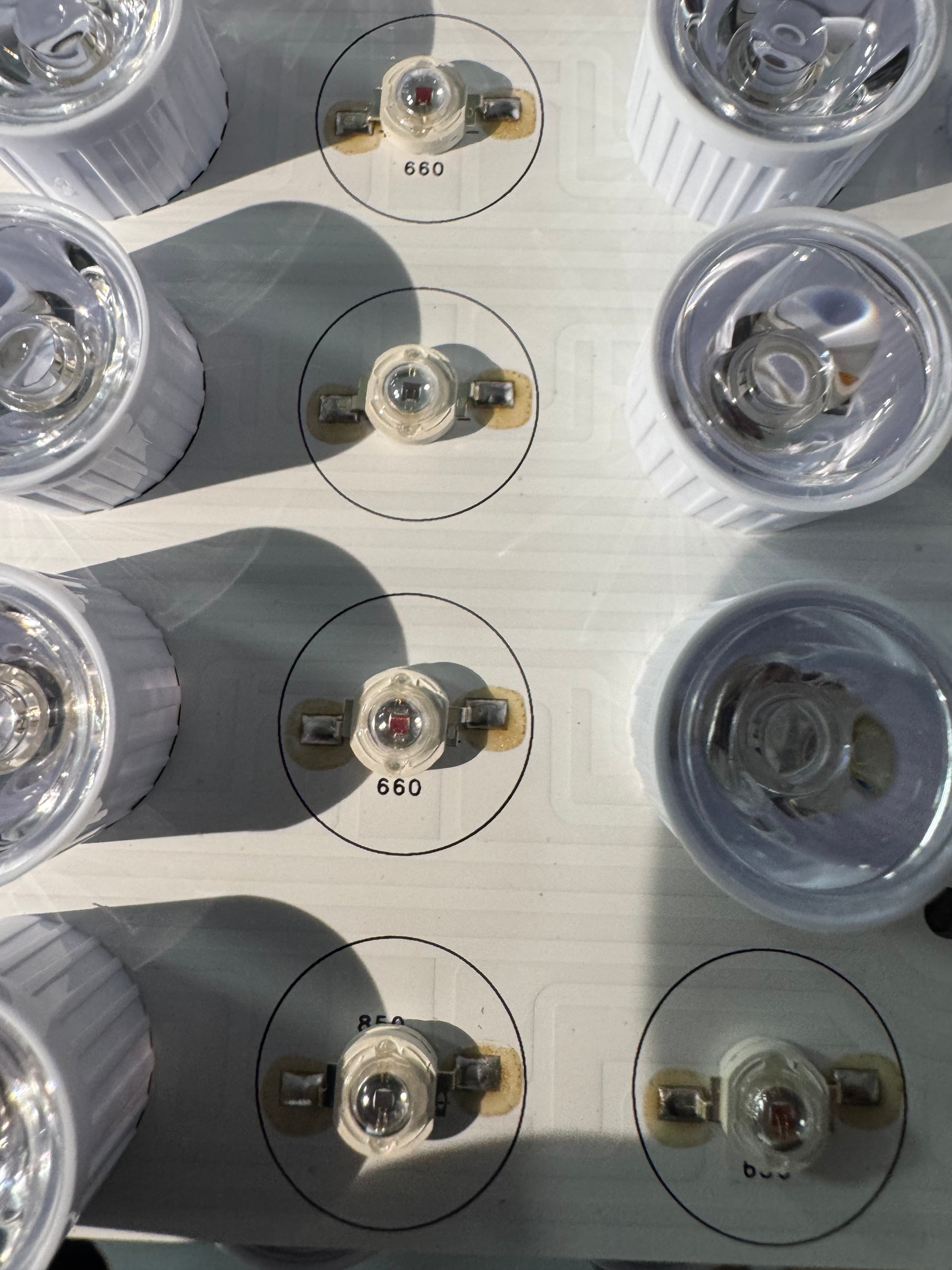
HeroSeries panels, HeroBelt and HeroHat use 660nm red light
810nm Research
- 810 nm and 670 nm light protect mouse retinal tissue from blue-light damage
In a lab study on retinal tissue from mice, ten minutes of 810 nm near-infrared or 670 nm red light given after six hours of damaging blue light boosted mitochondrial energy metabolism, reduced oxidative stress and cell death, and increased protective alpha-crystallin proteins; the authors identified respiratory complexes I and II as additional light targets beyond complex IV.
All HeroSeries panels use 810nm NIR light
830nm Research
- 830 nm LED Preserves Eye Health in Retinitis Pigmentosa Model
In a rat model of retinitis pigmentosa (a disease causing vision loss), short treatments with 830 nm LED light maintained cell energy levels, improved electrical signals in the eye, and protected retinal layers from damage, offering hope for slowing inherited eye degeneration.
- Multi-wavelength LED (680, 780 and 830 nm) protects the retina in a rat model of dry AMD
In rats given sodium iodate to mimic the oxidative retinal damage of AMD, five 2-minute sessions of combined 680, 780 and 830 nm LED light on days 1-5 protected the retinal layers, reduced cell death, prevented loss of rod bipolar cells and lowered toxicity in the retinal pigment epithelium. (multi-wavelength)
HeroSeries panels and face masks use 830nm NIR light
850nm Research
- Multi-wavelength LED therapy including 850 nm improves visual acuity in dry AMD over 13 months (LIGHTSITE III)
In a randomised, sham-controlled trial of 100 people (148 eyes) with intermediate dry AMD, nine-session courses of 590, 660 and 850 nm LED light repeated every four months produced a 5.4-letter gain in visual acuity at 13 months versus 3.0 letters with sham (a 2.4-letter difference), and fewer treated eyes developed new geographic atrophy, with a favourable safety profile. (590/660/850 nm multi-wavelength)
- Narrative review of photobiomodulation for AMD
This 2023 review of red and near-infrared light therapy (including the 590/660/850 nm device) for intermediate AMD concludes that early results for visual acuity and contrast sensitivity are encouraging, but that with only three randomised trials, varied protocols and small samples, whether the treatment shrinks drusen or prevents progression to advanced AMD remains uncertain.
HeroSeries panels, HeroBelt and HeroHat use 850nm NIR light
Did you know studies suggest red light therapy may support eye health with no reported adverse effects? A major scientific review analysing over 6,000 studies found no evidence of harm. However, because the eyes are a sensitive area and medical views are not unanimous, we provide protective goggles so you can make an informed decision with guidance from your healthcare provider.³
Devices informed by eyesight research³
-
HeroPanels Elite™ 10 Wavelength Red Light Therapy Panel
Regular price $1,199.00 - $6,698.00 AUDRegular price$1,199.00 - $6,698.00 AUDSale price $1,199.00 - $6,698.00 AUD -
HeroFilter™ 100% Blue Light Blocking Glasses
Regular price $159.00 AUDRegular price -
Hero60™ Tabletop Red Light Therapy Panel
Regular price $999.00 AUDRegular price -
Hero300™ Red Light Therapy Panel
Regular price $2,199.00 - $2,848.00 AUDRegular price$2,199.00 - $2,848.00 AUDSale price $2,199.00 - $2,848.00 AUD



Other red light therapy research
- Sleep quality
- Pain and inflammation
- Muscle mass and recovery
- Collagen production, skin and wrinkles
- Hair growth
- Neural function, depression and brain diseases
- ATP production and mitochondria function
- Injuries and wounds
See the studies for yourself by clicking the links above or visit our RLT Wavelength Research page for an overview.